header links

Saturday, September 22, 2012

Here's something your Mary On Board wouldn't say.....because her instructions would be HELPFUL and FUNNY

Tuesday, March 20, 2012

Driving Advice from: Wifeadvice.com

Driving Me Crazy
Here’s where we answer our our readers’ questions. Please don’t blame us if the suggestions don’t work for you. You’re the one taking advice from a donkey.

Dear Donkey and WifeMy husband often asks me to take a turn driving, but then he criticizes the way I drive the whole time. Why does he do this? What can I do?-Stuck at the Wheel

He Says
This is one of the few areas where I think the male mind may be as confusing as the female mind. On occasion I also ask my wife to drive, even knowing that I will have to sit frustrated in the passenger seat, unable to control my comments. Perhaps I can explain some of the things guys think about while they drive. I don’t think you should have to alter your style of driving, but this insight might help you see where he is coming from.
When my wife drives, I can’t understand why she’ll stop behind a line of 5 cars at a light instead of pulling up to the front of the open lane next to us. Whenever I spot a wide open lane, I feel like a special invitation from the heavens has been delivered to me, and I humbly accept the privilege to sit at the front of the line. Perhaps you could relate this to a shopping experience. Imagine you have just spent an hour grocery shopping with your kids. You’ve endured whining, begging for candy, and fights over who is sitting where in the cart. You finally make it to the checkout area; exhausted, you can’t wait to get out of there. Of course all of the lanes have long lines, and you shudder at the thought of controlling your children for another hour while the incompetent cashier fumbles to open little plastic bags. Just then, the light at the next checkout lane turns on, and a fresh, bright looking clerk beckons you—of course you rush to be first in line, in front of all the jealous onlookers. Who would not jump at the same chance on the road?
My wife also doesn’t appreciate the fine art of merging into traffic or changing lanes. She gets very flustered and will let anybody who bullies her go first. We have missed innumerable exits because of this timidity. As a guy, I relish in the opportunity to merge into traffic. It’s like a hot knife cutting through a block of butter, and it gets better as the number of lanes I just cut through increases. It reminds me of when I played Frogger, and the logs would line up just right, allowing me to hop across the whole screen. What could be better? Is it difficult for females to relate since they don’t play video games as much as men? Maybe you can relate it to changing a diaper. Picture the wipe going across the baby, slurping up everything in one fell swoop. Wouldn’t you want traffic merging to feel just like that? Anyway, I hope this insight helps you get a glimpse into our minds and why we think the way we do. As for what you can do, I suggest identifying times when having you drive is not optimal. For example, don’t drive when you are on your way to an appointment or to the movies. If you are like us, you will be running late and your husband will be whining all the way.


She Says
I feel your pain, dear reader. I have been “stuck at the wheel” on many occasions–stuck hearing about what lane I should have gotten into, how I need to drive faster and stop slower, how I ought to be responding a little less courteously to the driver who just cut me off. I usually just sit, trying to figure out what got me into the driver’s seat in the first place. It typically happens when I pick my husband up from work, and thoughtlessly stay behind the wheel, rather than sliding over to the much more relaxing passenger seat. Sometimes it is because I have been specifically asked to drive, like when he needs to work in the car or is about to fall asleep.
Whatever got me into the driver’s seat, though–the only thing that works for me is to repeat my motto: I would be more than happy to let you drive. I usually communicate this motto verbally, but at times drastic measures have to be taken. Like the night at the Blockbuster parking lot. Apparently I turned into the lot rather sharply, and apparently donkeys don’t like the cars they are riding in to bounce over curbs. After being reprimanded, I slammed on the brakes and exited the vehicle, leaving the car running in the middle of the parking lot with the driver’s door opened. Unfortunately, while I was simply trying to communicate, “I would be more than happy to let you drive,” my husband took my actions to say: “I don’t care if the person behind us runs into us, and I also want you to be forced to get out of the car, walk around to the driver’s seat, get in, and park the car yourself. After that you better come in and apologize. And you can bet that we are going home with a chick flick tonight.” I guess it’s true what they say–marriage is all about communication.

Friday, March 16, 2012

Dr. Robyn Silverman: Back Seat Driving Parents

Are you a back-seat-driving parent? 7 Ways to Keep Micromanagement of the Other Parent in Check

blog backseatdriver2 Are you a back seat driving parent? 7 Ways to Keep Micromanagement of the Other Parent in CheckWe all get annoyed when someone becomes a back-seat driver in our own car. “Slow down!” “Speed up!” “Why are you going this way???” Back-seat drivers can make us feel like bumbling fools or they can just simply drive us crazy.  But how can the same type of dynamic play out in the parenting relationship?
“You can’t say that!”
“Do it this way!”
“Just let me handle it.”
Gosh. Isn’t that annoying? Frustrating? Degrading? When one parent continually tries to tell the other parent where to go and what to do when it comes to the kids—or just takes the proverbial wheel out of his/her hands, it creates an unhealthy dynamic– one parent who constantly feels shamed, unsure and/or on the defensive and, what I call, a “back-seat-driver parent,” who hovers, corrects, and micromanages his or her partner.
We all only want the best for our children and our families.  So how can we keep our back-seat driving tendencies in check when it comes to our co-parenting style?
(1) Don’t auto-correct: When you see the other parent handling a problem or interaction differently that you would, pause. Cut the other person some slack! Nobody wants to feel that they can’t do anything without shaming, comparing, and immediate commentary. Remember–Just because they do things a different way, doesn’t mean it’s wrong.
blog backseatdriver1 Are you a back seat driving parent? 7 Ways to Keep Micromanagement of the Other Parent in Check(2) His/her best may be good enough or better: Don’t be so blinded by “your way” that you get in your own way of seeing that his/her way might be good enough or better.  Everyone has something to learn—and yes, everyone has something to teach too.
(3) Do it in private: When you disagree with the way that something was handled, don’t reprimand your partner in public.  Speak to him/her privately about what you disapproved of and how you think things could have been dealt with instead. And, even in private, allow respect to govern the conversation.
(4) Use specific rather than global remarks: Rather than making comments like “you always do that!” or “you are so argumentative!” be specific about what happened. “When you were with Molly this morning, you yelled a great deal rather than putting her in time out like we discussed yesterday.” When we make our remarks specific, you show that you don’t agree with a specific action, when we make them global, they seem like an attack on the other parent’s character.
(5) Open up a discussion as a united front: You are not always right.  When your children are behaving in ways that you don’t find acceptable, have a conversation with the other parent to discuss what to about it. Ask; how do you think we should handle this? Here are some of my ideas…” Listen as well as offering your own thoughts.
(6) Step in only when mistakes are detrimental: If safety or bad long-term repercussions seem imminent, step in. Just know the difference between differences in opinion and harmful conduct.
(7) Remember the values and lessons you hope to teach: When we consistently step in and cut the other parent off at the knees, we can inadvertently convey to our children that the other parent isn’t worthy enough, smart enough, or good enough.  We also demonstrate to our kids that if they have a difference of agreement with someone else—adult or otherwise—they can simply take the controls and do whatever they want. At the foundation of parenting, we always want to conduct ourselves with respect in order to both show respect to the other parent and teach the children the importance of respect in every relationship.
Most everyone has moments of back-seat driver parenting (whether by a co-parent or another family member) so it follows that most parents have also been on the receiving end of auto-correcting remarks or disapproving looks. We all make mistakes. It’s what we do on a daily basis that matter the most. Nobody is perfect—not the other parent, and yes, not you either! Step back and give yourself a break and while you’re at it, give that same gift to the person who is on your parenting team too.  On days that run long and tempers run short, we all deserve one!
drrobynsig170 Are you a back seat driving parent? 7 Ways to Keep Micromanagement of the Other Parent in Check

Tuesday, December 27, 2011

Don't rely on your GPS TOO much!

Have you ever been in a car when a driver was paying too much attention to the GPS and not enough attention to the road?

If so, and it resulted in a fender bender, it probably felt like a case of technology failing to do what it’s supposed to— make our lives easier, safer and more entertaining.

Well three women visiting Bellevue Washington for a Costco convention ran into similar trouble Wednesday. According to KATU it was just after midnight and the ladies were looking for their hotel when the driver, lead by the rental GPS unit, drove their SUV down a boat launch and directly into a lake. Neither of her friends stopped her.

No one was hurt— one woman immediately lept to the dock, while the other two balanced on the door frames until the car sunk too deep and they had to wade to safety.

Granted, the boat launch was not well lit, but one has to ask: wtf?

I think the quotes that Lt. Eric Keenan with the Bellevue Fire Department best illustrate this mishap.

“We’ve seen sitcom parodies of something like this and to actually see it is surprising,” he said.

“They were trying to re-route their path and found this boat launch near the entrance to I-90 in South Bellevue and just kept driving into the water.”

“I don’t know why they wouldn’t question driving into a puddle that doesn’t seem to end.”
Well put, Keenan. While it sucks that the GPS lead them astray, this is not the case of technology failing a driver, rather a case of a driver temporarily failing life.

Wednesday, October 26, 2011

The Back-Seat Driver in Your Dashboard

  • EYES ON THE ROAD

  • OCTOBER 26, 2011

  • The Back-Seat Driver in Your Dashboard

    New Interactive Features Are Aimed at Making Efficient Motoring Fun Like a Video Game

    [EYESROAD] Hyundai
    Hyundai's Veloster features a fuel-economy game that awards points for efficient driving. Scores can be shared with other drivers.
    Remember when Mom or Dad would nag you about wasting gas by driving too fast? Now your car can do it for them.
    Joe White on Lunch Break looks at how car makers are developing and installing new technology designed to coach you to drive more efficiently. Put simply, it's like having your back seat driving mom built into the car. But there are twists.
    Technology designed to coach you toward a more efficient style of driving is showing in many new cars. Options run the gamut from simple displays of fuel consumption, to interactive video games, to a gas pedal that actually pushes back when you stomp it.
    Auto makers view these features as lures for younger, cash-conscious and tech-savvy buyers. They might also help car makers meet coming federal fuel-efficiency standards. Research indicates these electric noodges can make a significant dent in fuel consumption, if drivers actually follow the advice the systems give them.
    Car makers are treading carefully. They want to engage their customers in the effort to conserve oil, but they don't want to irritate them and don't want to compromise safety by making eco-driving displays too distracting. Most of these technologies can be ignored or turned off if drivers choose.
    Hyundai
    Hyundai's Veloster
    At the far end of the in-car coaching spectrum is Nissan Motor Corp.'s Infiniti and its "Eco Pedal." It is a gas pedal that, in "Eco" mode, gently pushes back against your foot when the car's computers decide you're romping too aggressively on the accelerator. The brand began offering it as part of a $3,000 optional "technology package" with other advanced safety systems. About a fifth of the M-line buyers get the technology package, which also will be offered on the 2013 JX luxury crossover, due to be debuted in November, Infiniti says.
    Ford
    The Lincoln MKZ hybrid.
    Ford
    A gauge in the Lincoln MKZ hybrid features growing vines and leafs to reward drivers visually for efficient motoring.
    Hyundai Motor Co.'s sporty new 2012 Veloster three-door coupe has a fuel-economy game programmed into the screen that also displays the car's location, onboard entertainment and telecommunications. The "Blue Max" program measures the car's fuel economy every 10 minutes and displays a score. Drivers can share their score with other Veloster owners using the car's Blue Link wireless link.
    Fuel economy is important to the Veloster's young, target buyers, says Hyundai Motor America's senior manager for product planning, Brandon Ramirez. "Gen Y is into gaming," he says, which is why they chose a videogame format. Although the car just came out, Veloster owners are already comparing their scores in an online forum.
    It wouldn't be the first time drivers have turned trimming fuel use into a game: Some owners of hybrids and other cars compete with themselves and each other by "hypermiling," using various techniques to cut gasoline usage.
    Ford Motor Co. uses images of a plant that grows as drivers motor more efficiently in its Fusion Hybrid model. And Toyota's Prius and Camry hybrids offer detailed, displays of real-time fuel economy.
    Auto makers are experimenting with these features in part because future federal fuel-economy regulations could give them valuable credits under the Corporate Average Fuel Economy, or CAFE, rules for installing them. And researchers have found that gentle nagging by coaching systems works.
    Nissan
    Infiniti's M-series
    Nissan
    The gas pedals in Infiniti's M-series cars gently push back if stomped on when the optional 'Eco' mode is engaged.
    Researchers at the University of California, Riverside have been experimenting with ways to give drivers instantaneous feedback on their driving efficiency for about five years. UC Riverside researchers equipped the cars of about 20 people with devices that gave them information about their real-time miles per gallon. Seeing that information led to savings ranging from 5% to 15%, researchers say.
    Now, the researchers are embarking on a larger, three-year study, funded with $1.2 million from the Department of Energy. It's aimed at finding how much drivers can save if they have detailed information on the most fuel-efficient route to a destination—based on traffic and road conditions—coupled with coaching technology giving drivers instantaneous performance feedback.
    Savings "could go up to 30% under ideal scenarios," says Kanok Boriboonsomsin, one of the researchers on the project. It's a worthy goal, as boosting a car's mpg by 30% through hardware changes—lighter materials, new transmissions, or tiny engines—can be expensive.
    Still, the word "ideal" is important: Ideal conditions for driving in a fuel-saving manner aren't easy to find or sustain.
    I took a spin in one of the UC Riverside's test vehicles—a heavily modified Nissan Altima bristling with computers and antennae. Accelerating out of the parking lot, my real-time mpg sank well below the roughly 20-mpg target for city driving on the screen.
    Things improved coasting downhill, but when I accelerated up the on-ramp to merge with traffic, my real-time fuel economy dipped below 10 mpg.
    Michael Todd, a UC Riverside researcher who chaperoned my drive, says mashing the accelerator to get on a freeway can overwhelm the car's exhaust-scrubbing systems. So, not only is the car burning a lot of fuel, but it's adding a bigger-than-average load to air pollution.
    The message from the UC Riverside data is that relatively small changes in behavior can produce fairly substantial reductions in fuel consumption.
    The overall problem, Mr. Todd says, is that "most people aren't taught how to conserve fuel" when they learn to drive.

    Friday, October 14, 2011

    The Imported Sports Car

    The work of a certain timid but thorough lawyer was valued for its precision, so soon he was making money to buy himself a nice imported sports car.

    Not long afterwards he had the misfortune to get lost in the worst part of town, and when he stopped at a red light a huge, mean son-of-a bitch hauled him out of the driver’s seat.

    Drawing a circle around him on the pavement, the hoodlum told him not to set foot out of it unless he wanted the crap beat out of him. The delinquent proceeded to demolish the car, starting with the headlights and windows, when he heard the lawyer giggling.

    He moved on to the body and engine, but in between crashes he couldn’t help hearing gales of laughter.


    Finally, crowbar in hand, he came over to his victim and demanded, “What you laughing about? Your fancy car’s never gonna run again.”

    “So?” the lawyer gasped helplessly, tears running down his face. “Ever since you started tearing up my car, I’ve been stepping in and out of this circle, in and out, in and out…”

    Wednesday, September 21, 2011

    Report: Poor Driving Habits Can Lead to 45% Drop in Fuel Economy

    Published September 9, 2011
    Fuel Economy Center Console
    On the whole, hybrid drivers tend to be pretty attentive to the driving habits that can help them squeeze as many miles per gallon out of their cars' official EPA ratings as possible. Now, a new study suggests that all car owners should take care follow to proper eco-driving practices, and that failing to do so can hurt a vehicle's average fuel economy by as much as 45 percent.
    According to researchers at the University of Michigan's Transportation Research Institute, factors ranging from tire inflation to road selection can add up to transform even the most fuel-efficient gas cars into guzzlers. For instance, the owner of an EPA-rated 30-mpg vehicle with poor eco-driving practices could see his average fuel economy drop to as low as 17 mpg if he failed to hit a single point on the study's checklist—equal to the combined rating of a 2011 Land Rover.
    Report authors Michael Sivak and Brandon Schoettle divided these poor efficiency habits into three categories: Strategic decisions, which included engine tuning, tire rolling resistance, tire pressure, and motor oil use; tactical decisions, which included route selection, road grade profile, traffic congestion and load weight; and operational decisions, which included idling, speed, aggressive driving, and cruise control and air conditioner use. Of these factors, route selection, speed, and engine tuning demonstrate the highest potential to sap fuel economy.
    The study noted that real-world fuel economy in the United States is just 17.4 mpg, and has risen a paltry 3.4 mpg since 1923. The government-mandated Corporate Average Fuel Economy for cars was 27.5 mpg last year, but those numbers are determined by EPA testing—not by the real-world experiences of drivers. Sivak and Schoettle also point out that perhaps the most profound factor in the stagnancy of automotive transportation efficiency is vehicle occupancy. Since 1960, vehicle occupancy in the United States has fallen 30 percent, causing the average energy intensity of driving to rise by about 30 percent in turn.

    Does the Answer Lie in the Center Console?

    So if the simplest, most cost-effective ways to increase fuel economy sit not in the hands of manufactures but drivers themselves, how can we coax car owners to do the right thing? Much of the answer can come from the advanced computer systems being installed in many common vehicle models today. These high-tech center consoles were developed in part to help hybrid and electric vehicle drivers monitor their fuel economy and state of battery charge, and have been integrated with GPS navigation and “infotainment” systems to radically alter the driving experience.
    Factors like route selection and driving aggression can already be optimized using systems currently found in most hybrids—some of which coach users on the best ways to improve fuel economy as they drive. Computer monitoring of maintenance issues like tire pressure and engine tuning could also help to lead car owners to better eco-driving habits.
    While which car you drive can make all the difference in the world, it certainly isn't the only factor in determining fuel economy. In theory, a combination of good car maintenance, smart driving and carpooling can be just as powerful a fuel-saver as buying a green car. So why not just do both?

    Monday, September 19, 2011

    GPS Drama

    Drama with the GPS

    We named the GPS Sheila, but decided to pronounce it all redneck like and actually call her Shayla. By we, I mean Adam, because he is forever naming random items.

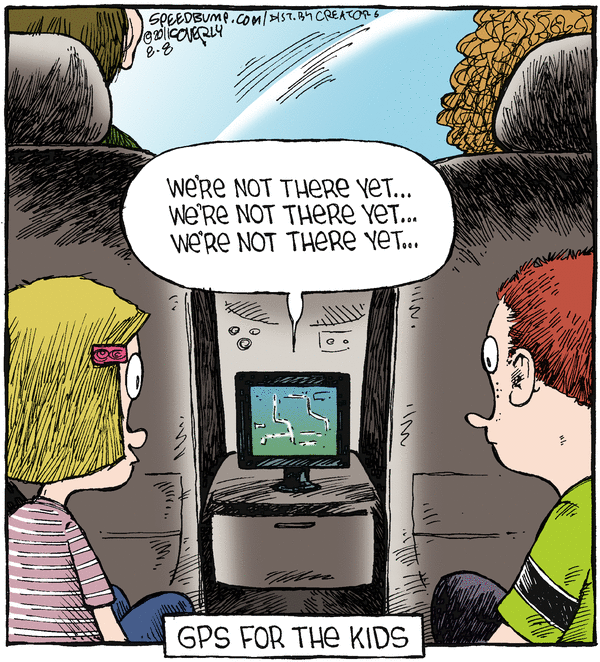
    We put our destination in and pretty much left our road travel fate in Shayla’s hands. The only problem was that she got a little angry when we strayed from her directions.

    If we stopped at a gas station, Shayla would begin shouting that she was, “recalculating.” She was really pretty hateful about it. Persistent, also: She would shout “recalculating” until we got back on our path.
    Shayla honestly got a little out of control. She started taking us on crazy roads, and I think perhaps she is the crackhead, anthropomorphized version of a GPS. Like if your GPS is Albert Einstein, mine is Amy Winehouse. Except we call her Sheila/Shayla and she isn’t British like many GPS voices. (Which makes me sad, I desperately wanted a GPS with a nice foreign accent.)

    Anyway, at some point in our trip Shayla starts having us make turns every 1.5 miles onto back roads that looked as if they were rarely, if EVER, traveled. One of them was even half gravel. I’m not even kidding. It was like the episode of The Office where Michael trusts his GPS and follows its instructions exactly as given. In the end, the GPS drives him into the lake. That was us. Michael Scott just following the GPS until it takes us somewhere bizarre.
    (This is a nice time to insert how much I LOVE THE OFFICE! Love, love, love!)

    Most of the trip was spent cussing Shayla. Like the time she directed us to turn too early and then blamed the turn on us.

    “RECALCULATING … RECALCULATING … RECALCULATING!” Shayla shouted. As if she was the one put out by her shitty directions?

    “@#$%^&^%$%# SHAYLA!” Adam screamed in frustration, “You keep giving us all of the wrong directions.”

    This went on and on and on. The directions weren’t incorrect. They were just long and full of turns. The sort of directions your grandmother might give you to the grocery store, because she doesn’t believe in the interstate. That’s Shayla. Your fitful granny.

    You would think we would wise up on the way back and find our own path, but if you did think that, you would be wrong. We put our fate in Shayla’s hands? Again! She took us home a completely different way, and in the course, drove us through four different states. FOUR DIFFERENT STATES.

    “DAMN IT, SHAYLA!” Adam screamed some more. The only problem was that Shayla doesn’t respond kindly to cursing. Shayla doesn’t respond kindly to anything. In fact, she seemed to lose satellite signal not long after that. Leaving us out of luck and following the maps on my iPhone.

    But eventually, we did get home. Shayla is buried in my trunk beneath all of the crap I never, ever get plan to get out like stray flip flops and the pieces of gravel Allie picks up when she wants to collect rocks. Shayla is there, and I’m pretty sure she will stay there for a very, very long time.

    Monday, August 8, 2011

    What will they think of next?

    Woman Sues Google for Bad Directions


    One day I was using my cell phone's GPS service to find the nearest Target. I was driving down the road when suddenly my cell phone piped up, "Turn right here." I looked to the right. There was no road, just a tree and some grass. I chalked it up to a GPS glitch and turned right at the next corner.

    If I had been Lauren Rosenberg, however, I would have turned right at that very moment, hit the tree, suffered some cuts and minor brain damage, and then turned around and sued Verizon for the glitch in its GPS service.


    Seriously.


    Search Engine Land reports that Rosenberg, a Los Angeles California native, is suing Google because Google Maps issued directions that told her to walk down a rural highway. She started walking down the highway--which had no sidewalk or pedestrian paths--and was struck by a car. She is suing Google for her medical expenses ($100,000), as well as punitive damages. She is also suing the driver who struck her, Patrick Harwood of Park City, Utah.


    On January 19, 2010, Rosenberg was apparently trying to get from 96 Daly Street, Park City, Utah, to 1710 Prospector Avenue, Park City, Utah. She looked up the walking directions using Google Maps on her Blackberry. Google Maps suggested a route that included a half-mile walk down "Deer Valley Drive," which is also known as "Utah State Route 224."


    There's not much more to say--she started walking down the middle of a highway, and a car hit her. Who wouldn't have seen that one coming?


    According to Rosenberg's complaint filing"As a direct and proximate cause of Defendant Google’s careless, reckless and negligent providing of unsafe directions, Plaintiff Lauren Rosenberg was led onto a dangerous highway, and was thereby stricken by a motor vehicle, causing her to suffer sever permanent physical, emotional, and mental injuries, including pain and suffering."

    Google actually does offer up a warning about its walking directions--if you view Google Maps on a computer, it gives you the following message: "Walking directions are in beta. Use caution--This route may be missing sidewalks or pedestrian paths."

    This warning does not show up in PDA's and cell phones, however. I suppose Google figured that people who are smart enough to use Blackberries are probably also smart enough to not walk directly into the middle of traffic.

    For the record, when I look up driving directions from my current city (San Francisco, California) to the city I grew up in (Tokyo, Japan), Google Maps suggests I kayak across the Pacific Ocean (with a rest stop in Hawaii, of course).


    I can't wait until Ms. Rosenberg tries to travel overseas ("The plaintiff was unaware that attempting to kayak 5,100 miles is an unreasonable endeavor").